The Rajasthan Calendar January 2026 (राजस्थान कैलेंडर 2026 जनवरी) answers exactly that, laying out every major festival, fast, and holiday for the month in one simple, easy-to-read guide. From the winter chill of New Year’s Day to the kite-filled skies of Makar Sankranti and the yellow of Vasant Panchami, January is one of Rajasthan’s busiest and most colourful months.
This guide also fixes a few dates that tend to get mixed up or listed incorrectly on some calendars — like which Ekadashi actually falls when, and when Kumbha Sankranti really happens — so you can plan with confidence.
Download the Rajasthan Calendar January 2026 PDF (Free)
If you’d like to keep this month’s dates handy without checking your phone every time, you can save the Rajasthan Calendar January 2026 as a PDF. It carries the same festival, Vrat, and holiday dates covered in this article, laid out simply enough to print for your kitchen wall or shop.
- Scroll to the download link at the end of this article.
- Tap “Download PDF” — it opens in a new browser tab.
- Save it to your phone or laptop using the share/download icon, or press Ctrl+S (Cmd+S on Mac) on desktop.
- Print a copy if you’d rather have it on paper.
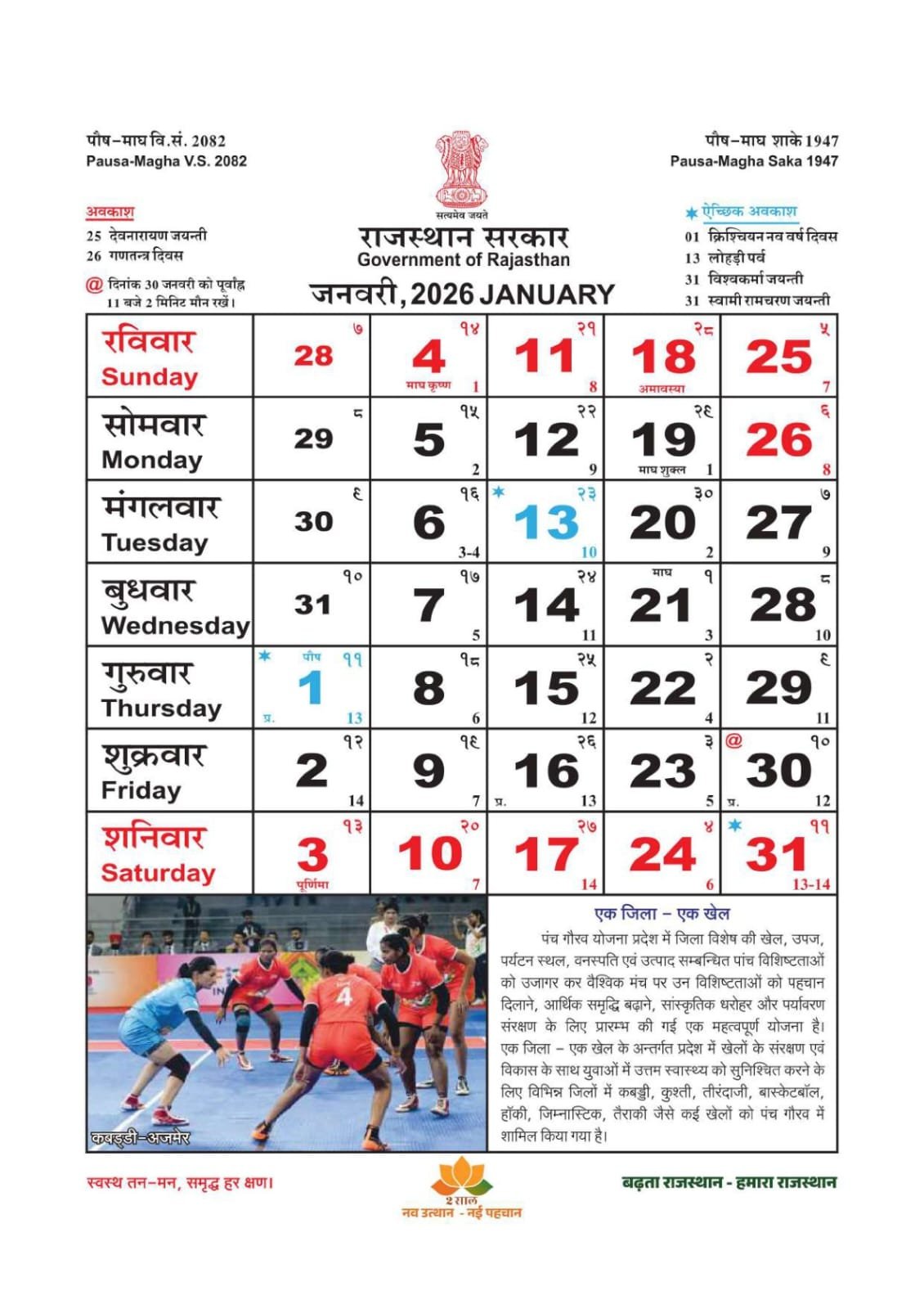
Rajasthan Calendar January 2026 at a Glance
| Date | Day | Occasion |
|---|---|---|
| Jan 1 | Thursday | New Year’s Day |
| Jan 3 | Saturday | Paush Purnima; Pradosh Vrat (Shukla) |
| Jan 6 | Tuesday | Sakat Chauth |
| Jan 10 | Saturday | 2nd Saturday Bank Holiday |
| Jan 12 | Monday | Swami Vivekananda Jayanti |
| Jan 14 | Wednesday | Shattila Ekadashi & Makar Sankranti (Kite Festival) |
| Jan 16 | Friday | Masik Shivaratri |
| Jan 18 | Sunday | Mauni Amavasya |
| Jan 22 | Thursday | Vinayaka Chaturthi |
| Jan 23 | Friday | Vasant Panchami; Netaji Subhas Chandra Bose Jayanti |
| Jan 24 | Saturday | 4th Saturday Bank Holiday; Skanda Sashti |
| Jan 25 | Sunday | Ratha Saptami |
| Jan 26 | Monday | Republic Day; Bhishma Ashtami; Masik Durgashtami |
| Jan 29 | Thursday | Jaya Ekadashi |
A Quick Correction Worth Knowing
A few calendars circulating this year list Kumbha Sankranti on January 15 — but that’s not correct. Kumbha Sankranti, when the sun moves into Aquarius, actually falls on February 13, 2026, almost a month after Makar Sankranti, not the day after it. Similarly, some lists show a second Ekadashi at the very end of January (often labelled Putrada Ekadashi) — this Ekadashi actually already took place in late December 2025, before Paush Purnima, so it doesn’t belong on the January 2026 calendar at all. This guide sticks to dates checked against current Panchang sources.
New Year’s Day, January 1
January opens with the Gregorian New Year, celebrated across Rajasthan’s cities with family gatherings, temple visits, and — in Jaipur, Udaipur, and Jodhpur especially — a busy start to the winter tourist season.
Paush Purnima & Pradosh Vrat, January 3
Paush Purnima, the full moon of Paush month, is considered ideal for a Satyanarayan Katha and an early holy dip where possible. The same day carries a Pradosh Vrat, an evening fast for Lord Shiva observed roughly 90 minutes around sunset.
Sakat Chauth, January 6: A Mother’s Fast for Her Children
Sakat Chauth — also known as Sankat Chauth or Tilkuta Chauth — is observed on Krishna Paksha Chaturthi of Magh month, and it holds particular significance in Rajasthan. There’s even a village literally called Sakat, near Alwar, roughly 150 km from Jaipur, home to a Sakat Mata Temple that draws devotees from across the state on this day. Mothers keep a day-long fast for their children’s health and long life, breaking it only after sighting the moon in the evening and offering til (sesame) and gud (jaggery) sweets.
Bank Holidays: 2nd & 4th Saturday
A practical note worth keeping handy — banks across Rajasthan, like the rest of India, remain closed on the 2nd and 4th Saturday of every month. In January 2026, that falls on January 10 and January 24. If you have banking work planned, it’s worth checking this before heading out.
Swami Vivekananda Jayanti, January 12
A fixed date every year, January 12 marks the birth anniversary of Swami Vivekananda and is observed nationally as National Youth Day, with schools and colleges across Rajasthan holding speeches, quizzes, and cultural events in his memory.
Makar Sankranti, January 14: Rajasthan’s Kite Festival
Makar Sankranti is arguably the most visually spectacular day of the month in Rajasthan. As the sun enters Capricorn and Uttarayan begins, the skies over Jaipur fill with thousands of kites — the city’s International Kite Festival, held around Makar Sankranti every year, draws kite-flyers from across India and abroad to Polo Victory Ground and rooftops citywide. Til-gud sweets are exchanged, khichdi is donated to the needy, and families take an early holy bath wherever a river or temple tank is nearby. This year, Shattila Ekadashi coincides with the same date, so many households complete their Sankranti charity earlier in the day and observe the Ekadashi fast alongside it.
Masik Shivaratri, January 16
The monthly observance of Lord Shiva, falling on Chaturdashi, the day before Amavasya. Devotees offer water and Bilva leaves at a Shivling, and many keep a partial fast as a smaller rehearsal for Maha Shivaratri later in the year.
Mauni Amavasya, January 18: A Day of Silence
Mauni Amavasya, the new moon of Magha month, is one of the year’s most spiritually significant days. “Maun” means silence, and many devotees observe a Maun Vrat — staying silent for part or all of the day — alongside an early morning bath and Tarpan (offerings to ancestors).
Vinayaka Chaturthi, January 22
This monthly Chaturthi, falling in Shukla Paksha just before Vasant Panchami, is dedicated to Lord Ganesha and considered auspicious for starting new work. Devotees typically observe a day-long fast broken after moonrise.
Vasant Panchami & Netaji Bose Jayanti, January 23
Vasant Panchami opens the door to spring and is dedicated to Goddess Saraswati, worshipped for wisdom, learning, music, and the arts. Schools and music schools across Rajasthan hold Saraswati Puja on this day, with yellow — echoing the mustard fields in bloom — as the traditional colour worn. The same date is also Netaji Subhas Chandra Bose Jayanti, a fixed national observance marking the freedom fighter’s birth anniversary.
Skanda Sashti & Ratha Saptami, January 24–25
Skanda Sashti, dedicated to Lord Kartikeya (Skanda), falls on the sixth day of Shukla Paksha and is observed with particular devotion in South Indian communities, though it’s marked by Murugan and Kartikeya devotees across the country. The very next day, Ratha Saptami honours the Sun God, marking his symbolic turning of the chariot toward the northern hemisphere — an early holy bath is considered especially meritorious on this date.
Republic Day, Bhishma Ashtami & Durga Ashtami, January 26
Republic Day, India’s Constitution Day, coincides this year with two religious observances — Bhishma Ashtami, commemorating the day Bhishma Pitamah chose to leave his body on the battlefield of Kurukshetra, and Masik Durgashtami, a monthly fast dedicated to Goddess Durga. Government offices and schools across Rajasthan remain closed for the national holiday.
Jaya Ekadashi, January 29
The month’s second Ekadashi, Jaya Ekadashi is linked in scripture to freedom from past mistakes and sins. As with all Ekadashis, rice and grains are avoided, and the fast is broken the next morning after sunrise.
Rajasthan’s January Cultural Calendar
Beyond the religious calendar, January is also peak season for some of Rajasthan’s best-known cultural events. The Bikaner Camel Festival, usually held in the first half of the month, celebrates the desert state’s camel heritage with parades, races, and folk performances. Jaipur, meanwhile, typically hosts the Jaipur Literature Festival later in the month, drawing writers and readers from around the world. Both are worth factoring into travel plans if you’re visiting Rajasthan this January, alongside the temple and Vrat calendar covered above.
Wedding and Griha Pravesh Muhurat in January 2026
Once Uttarayan begins on Makar Sankranti, January 14, the wedding season generally resumes after its winter pause. The Lala Ramswaroop and other North Indian Panchangs typically mark several favourable dates through the rest of the month, supported by a cluster of good Yogas and a suitable placement of Guru (Jupiter) and Shukra (Venus). As always, this is only a general window — the Kundali, Rashi, and Gun Milan of both partners should be checked individually by a qualified pandit before any date is finalised.
Reading the Panchang Beyond Festival Names
A Panchang isn’t only useful for spotting festivals — it also guides everyday decisions like starting a business, buying a vehicle, or beginning a journey. Each date carries its own Tithi, Nakshatra, and Choghadiya (auspicious time blocks). If you’re using a printed Rajasthan or Lala Ramswaroop Panchang, look for the Rahu Kaal and Choghadiya columns specific to your own city, since these are usually printed separately from the main festival table.
Tips for Observing January’s Fasts
- Sakat Chauth: A day-long fast broken after moonrise, with til and gud offerings.
- Shattila and Jaya Ekadashi: Rice and grains are avoided, with the fast broken after sunrise the next day.
- Mauni Amavasya: Many devotees keep a Maun Vrat alongside an early holy bath wherever possible.
- Pradosh Vrat: Best observed with evening prayers roughly 90 minutes around sunset.
Anyone managing a health condition, pregnancy, or age-related concerns should adapt fasting sensibly, and checking with a doctor first is always wise before a demanding fast.
Why This Panchang Is Still So Widely Trusted
Whether it’s a Rajasthan Panchang, Lala Ramswaroop, Thakur Prasad, or Kishore Jantri, printed almanacs remain popular across households because they combine city-wise sunrise and sunset timings with Tithi, Nakshatra, and Choghadiya details in one place. Families don’t check them once and set them aside — priests use them to fix Muhurats, and homemakers use them every month to decide the right day for a Vrat. Since different publishers can occasionally list a date a day apart, it’s worth sticking to one carefully checked source through the year.
Frequently Asked Questions
When is Makar Sankranti in Rajasthan in 2026? Makar Sankranti falls on Wednesday, January 14, 2026, marked in Rajasthan with kite-flying, especially Jaipur’s International Kite Festival.
Is Kumbha Sankranti in January 2026? No. Kumbha Sankranti falls on February 13, 2026, not in January — this is a common mix-up on some calendars.
When are the bank holidays in Rajasthan in January 2026? Alongside Sundays, banks are closed on the 2nd Saturday (January 10) and 4th Saturday (January 24), plus Republic Day on January 26.
How many Ekadashi fasts fall in January 2026? Two — Shattila Ekadashi on January 14 and Jaya Ekadashi on January 29.
When is Vasant Panchami in 2026? Vasant Panchami, also observed as Saraswati Puja, falls on Friday, January 23, 2026.
Can I download the Rajasthan Calendar January 2026 PDF for free? Yes. The PDF version, with the same festival, Vrat, and holiday dates covered here, is free to download with no login required.